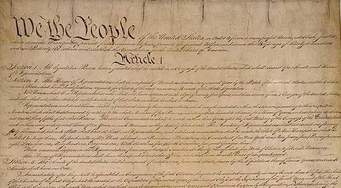
 Constitution Day commemerates the day the Constitution was signed by those who wrote it at the Constitutional Convention in 1787. It is also observed as citizenship day. Schools generally provide education about the Constitution on this day. Delaware was the first state to ratify the Constitution December 7 that same year. In 1790 Rhode Island became the last of the original thirteen states to ratify. George Washington became president in 1789.
Showing posts with label U.S. Constitution. Show all posts
Showing posts with label U.S. Constitution. Show all posts
Wednesday, September 28, 2016
Constitution Day September 17, 1787
Constitution Day commemerates the day the Constitution was signed by those who wrote it at the Constitutional Convention in 1787. It is also observed as citizenship day. Schools generally provide education about the Constitution on this day. Delaware was the first state to ratify the Constitution December 7 that same year. In 1790 Rhode Island became the last of the original thirteen states to ratify. George Washington became president in 1789.

Sunday, September 25, 2016
Chapter Review: The Constitutional Debate in Virgiania
The constitutional debate pitted Alexander Hamilton arguing against the ratification of the constitution, while James Madison argued for ratification. The federalist, those for the constitution, had decided that a stronger federal government was needed to ensure the continued existence of our nation. Those who argued against did not want a more central government which they equated with kings and tyranny. Edmond randolph spoke for ratification, while George Mason spoke against the document without a Bill of Rights. James Madison felt his side, the Federalist were winning. But that was before Patrick Henry stood to talk, and point by point tore the constitution apart. It was almost to the point of blows between he and Randolph. However, the next day, Hamilton came back and only spoke of the need for a Bill of Rights, which was put to a vote as an amendment. The Federalist argued the Bill of Rights could be added after ratification. However, passing amendments would but all those states who had already ratified the Constitution back in the ratification stage. The vote for the amendments was close, but did not pass. With that vote the vote for ratification of the Constitution also passed. However wise minds prevailed, and a Bill of Rights was added to the constitution.
This is a summary of the chapter in Glenn Beck: Miracles and Massacres: True and Untold Stories of the Making of America.
This is a summary of the chapter in Glenn Beck: Miracles and Massacres: True and Untold Stories of the Making of America.
Monday, August 1, 2016
Chapter Review: Shay's Rebellion, Glenn Beck
Miracles and Massacres: True and Untold Stories of the Making of America, Glen Beck with Kevin Balfe and Hannah Beck, Threshold Editions, Mercury Radio Arts, New York, 2013.
This chapter tells a story I was not familiar with, but was mentioned in the Revolutionary War exhibit at the Museum of Idaho in Idaho Falls. Of course Glen Beck has many more derails.
What would become known as Shay's Rebellion, had its spark and birth in rural Massachusetts. Taxes and debt were killing the rural farmer, while those in rural areas saw the wealthy bankers getting rich. This was ten years after the Americans had won their independence. It seemed. The courts were to blame, as they were used to collect debt and enforce rates. So this rebellion from several rural counties set out to shut down the courts, and this they did, staging gatherings around the court houses.
Daniel Shays had been in the Revolutionary. War, and was drafted to be the leader. Once in Shays was committed. The government was able to regain some control using local militias. However more assistance was needed. The rebellion's goal was to take the federal armory in Springfield, MA which held guns and ammunition. Although federal troops had been sent to support the local militia, they had not arrived. The people of the rebellion had planned attack from three sides, however the leader of one side had second thoughts, and they were not there. The defenders also had cannon. When the attack came, cannon fire chased them off, killing four men. The rebellion men retreated a couple miles. When the Federals arrived, they pursued to mop things up. Shays was captured. The men of the rebellion were pardoned, except two young men who were stealing supplies after hostilities were over.
Shay's Rebellion became motivation for a Constitutional Convention, to shore up the government and prevent further deterioration of the government.
Wednesday, July 13, 2016
The Iroquois Confederacy: Ancient Wonder of North America

One of the Ancient Wonders mentioned in the book, "Seven Wonders of Ancient North America" is not a place or a thing, but an idea. The idea of living peacefully. The Native American groups of the northern New York area, spilling into Canada, lived a live of violence, fighting one group against another, which included cannibalism. Hiawatha and the Peacemaker saw a different way. Dreams played an important part. The negotiated and brought five tribes together into a confederacy. Originally five tribes joined the confederacy. They were Seneca, Cayuga, Onondaga, Oneida and Mohawk. They were joined later by a sixth, Tuscarora. They were the confederacy of the long house. The confederacy originally formed in the 1100s, and it is still going today, making it the longest democratic system in the world. Ideas from the confederacy were used in shaping the Constitution.
Monday, June 13, 2016
Book Review: The 19th Amendment
We The People: The 19th Amendment by Michael Burgan, Compass Point Books, Minneapolis, Minnesota, 2006.
This is a very brief look at the struggle for women’s suffrage in America, and as such equal rights. The women’s struggle for suffrage began as early as 1848 in upstate New York with a first meeting at Seneca Falls. Elizabeth Cody Stanton and Lucretia Mott were the force behind the movement at that time. Susan B. Anthony was also much involved. The suffrage movement, and the movement for abolition of slavery saw many of the same characters, as thee women were also involved in collecting signatures to free the slaves. Frederick Douglas and Harriet Tubman were also involved in the suffrage movement. Initially the struggle involved victories in territories and states. Wyoming was the first territory to grant the right to vote to women in 1869, followed by Utah territory in 1870. Colorado and Idaho were the only other areas to grant the right to vote before the turn of the century. However state to state victories were too slow. Finally it was determined that a nationwide amendment was the only way to win the right to vote for women. Again there were two strategies, a more confrontational attitude, and another that worked within the politics of the day. There were many marches in Washington, trying to put pressure on politicians, and particularly President Woodrow Wilson. After passage in Congress 36 states were needed to ratify the amendment. Tennessee ended up being the 36th state, and the 19th amendment became law:
The right of citizens of the United States to vote shall not be denied or abridged by the United States or by any state on account of sex.
Subscribe to:
Posts (Atom)