Showing posts with label Little Big Horn. Show all posts

Sunday, July 10, 2016

American Biography: George Armstrong Custer

Having come upon the camps of Crazy Horse and Sitting Bull, Custer but have thought he was headed to a great victory.  Custer had a strategy he had used before.  He planned to get behind the encampment, capture women and children and elderly and use them as negotiating collateral or at least human shields.  This strategy had worked for him before.  Native American warriors were very protective of their women and children.  He split his 800 men into three columns.  Captain Reno was to attack from the South, forcing the encampment to respond.  He would then swoop down out of the mountains in the rear with his larger force.  He knew he was out numbered.  It wasn't until later he realized the actual size of the encampment.  Captain Reno's attack was repelled.  They only made it to within a mile of the encampment, and turned around and retreated, suffering many losses.  Worse for Custer was the the Native Americans guessed his strategy, and were waiting for him when he initiated his attack.  Custer's men did not retreat, but penetrated the Native American forces, until they were completely engulfed and their fate inevitable.  Neither Captain Reno nor Captain Benteen who had been called back from a scouting mission came to his aid.  They remained dug in on Reno Hill.
When hearing of the battle President Grant would say, "I regards Custer's Massacre as a sacrifice of troops, brought on by Custer himself; that was wholly unnecessary--wholly unnecessary."

Before these events Custer had a significant military career.  He was still a struggling student at West Point when the Civil War commenced.  He was from the lower part of the class, and often received demerits.  However they were rushed through, and Custer was with the troops at First Big Run, having found his own mount.  He became a part of General McClellan's staff.  He was also brash and aggressive, and a bit impulsive.  He was also criticized for his pursuit of praise.
Custer and his cavalry had a major role at Gettysburg.  He had been promoted to brigadier general just before the battle, and at 23 the youngest general.  His troops charged into Jeb Stuart's calvary, and repulsed their attack.  He thus protected the Union line from Stuart's flanking moves.  Stuart was forced to withdraw, the first time in the war his calvary had been stopped.
He fought with General Sheridan in the Shenandoah Valley.  At the end of the war, his cavalry got in front of Lee, and prevented his escape, and thus forced his surrender at Appomattox.
Custer came out of the Civil War as a national hero.  During the war he he also married.  His wife would go with him to his outposts throughout his career rather than be left behind.  However he still wanted to fight, and used his influence to become Lieutenant Colonel of the Seventh Calvary fighting the Plains Indians.  However he discovered the same tactics would not work.  The Indians would attack and then dissipate, and they were hard to find.  At one point Custer became discouraged, and left the field of battle returning to his wife.  He was court-martialed and found guilty of desertion, and suspended for a year.  However he was recalled more quickly than this because of the need.  The Indians were becoming more bold.  He was ordered to destroy villages and kill warriors.  In pursuit of a group that had been attacking settlers, he cam upon a village of Cheyenne.  Rather than wait for his scouts intelligence he attacked, and killed Black Kettle and many of his men.  Black Kettle was a peaceful Indian and was displaying a white flag of truce.
Custer's was involved in the discovery of gold in the Black Hills, or at least protecting the prospectoers.  This was significant as this area was holy ground to the Sioux.
Custer's rush to fame would prove fatal to he and his men at the Battle of Little Big Horn.  Custer would always wear buckskin into battle.  He said this was so his men could easily identify him and gather around him.  That Custer was failed by Benteen and Reno is true.  When Benteen arrived on the scene he reinforced Reno rather than Custer.  This was an order from Reno, his commanding officer.  Reno was accused of incompetence or drunkenness. This was not substantiated.

Monday, June 20, 2016

Book Review: A Pictographic History of the Oglala Sioux

Native American Dance

A Pictographic History of the Oglala Sioux drawings by Amos Bad Heart Bull, text by Helen H. Blish, University of Nebraska Press, Lincoln, 1967.
This is the most fascinating book.  Amos Bad Heart Bull drew sketches of the history of the Sioux, as he lived, or was told to him.  This pictures depict Crow vs Sioux battles, dances, Little Big Horn, Wounded Knee, Indian ceremonies, Sioux games, Sioux life and much more.  It includes a section of pictures in color, but most are in black and white.  Helen Blish asked the younger sister of Amos Bad Heart Bull if she could study his drawings.  This book is the result.  The originals were buried with the sister.
Victory Dance or Scalp dance, the items displayed are scalps and human parts.

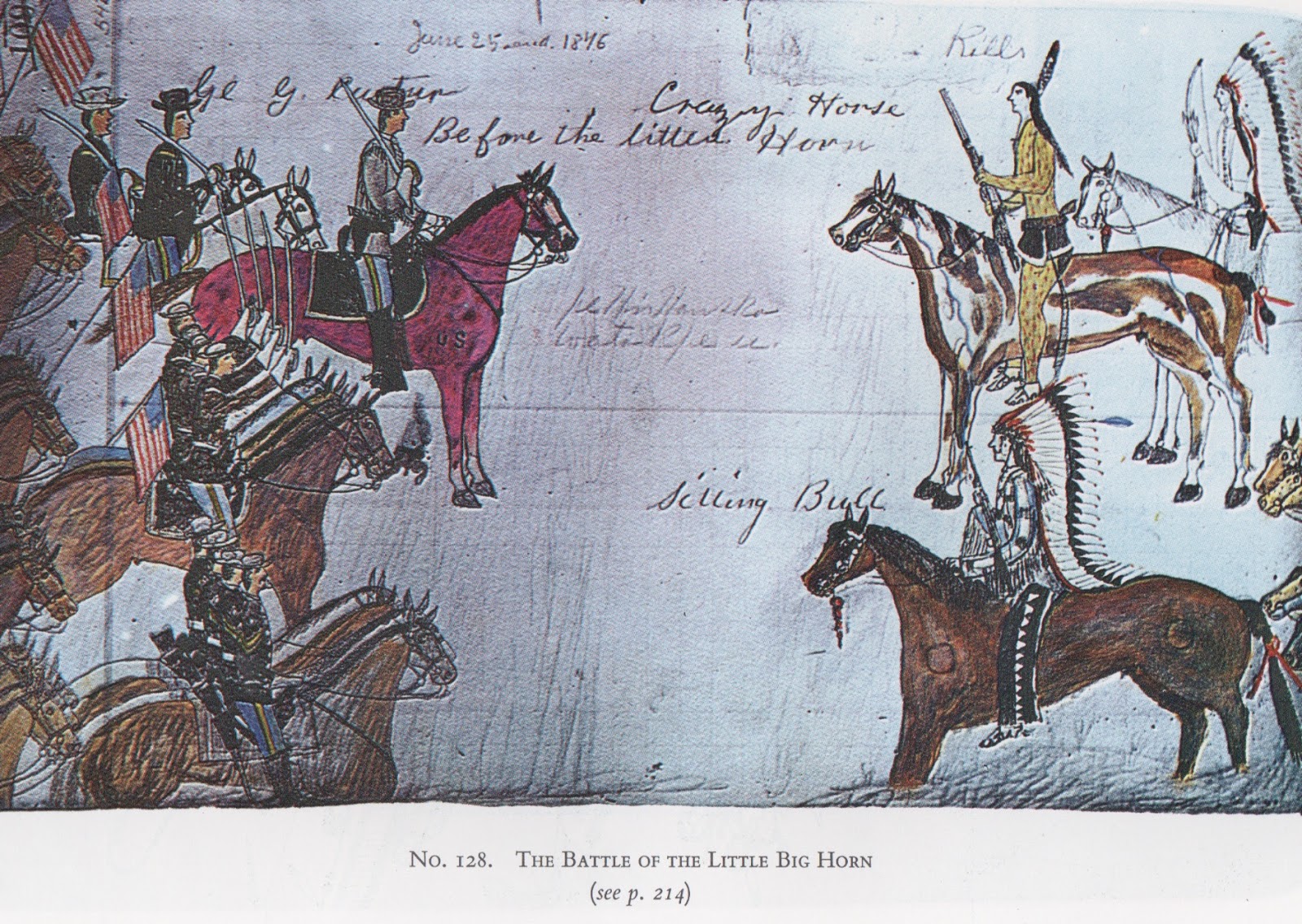
Principle Character, Little Big Horn, George Custer, Crazy Horse and Sitting Bull, picture is symbolic

Crazy Horse and Sitting Bull

Initial Attack by Captain Marcus Reno

This attack is turned by Bad Heart Bull, Kicking Bear and Hard to Hit.  Bad Heart Bull is father of artist, Kicking Bear was at Wounded Knee


This picture shows Crazy Horse in the action

Captain Reno's men in the water

This depicts Crazy Horse killing Custer with a tomahawk.  Custer's was the second thrust at the encampment and was meant to catch them by surprise from behine.  However Gall and Crazy Horse were ready for them.  They did not return and retreat like Captain Reno, and penetrated enough into the Indian warriors that the were surrounded and cut off. 

This depicts the killing of Crazy Horse.  He gave himself up, and thought he would be sent to a reservation.  Instead when they went to jail him he began to resist, he attempted to draw a knife and was bayoneted by a guard

Principal character at Wounded Knee, Chief Kicking Bear and General Nelson Miles with Grant Short Bull in the middle.  I think this is again a symbolic representation

Samples of Ghost Dance outfit which was suppose to stop bullets

Murder of Sitting Bull and his son who was shot while in bed.  Native American Guards came to arrest Sitting Bull for not stopping the Ghost Dance.  There was a struggle and Sitting Bull was killed.  

Ghost Dance Ceremony

Ghost Dance song
Ghost Dancers surrounded by infantry and horse troops  (there were also four gatling guns present)

The Massacre

Women Dancing

Monday, May 30, 2016

Native American Biographies: Plenty Coups: Crow

More than anyone Plenty Coups was responsible for the U.S. Army having a supply of Indian scouts.  Plenty Coups was the principal chief of the Crows during the later stages of the Plains Wars.  It was he who decided to ally his people with the U.S. Army and cooperate with them.  As such they fought against traditional enemies, Sioux, Arapahoes and Cheyenne.  When he was nine one of this brothers was killed by the Sioux, creating a life long enmity.  Crow scouts were attached to General George Armstrong Custer and some of them died at Little Big Horn.  Plenty Coups encouraged his people to farm.  He himself opened a store so his people would have fair prices.  He visited Washington, D.C. several times.  During WWI he encouraged his young people to join the military, and thereby forfeit the idleness and alcoholism on the reservation.  He represented all Native Americans at the dedication of the Tomb of the Unknown Soldier.

Tuesday, April 5, 2016

Native American Biographies: At Little Big Horn

Crazy Horse and Sitting Bull are well known for their exploits at Little Big Horn.  They were the leaders of the Native American Forces.  Different sources have different stories of Sitting Bull's participation.  He had been involved in a Sun Dance, and was weakened.  As a result of the dance, he saw the Federals coming and new the Native people would have a great victory.  However because he was weaker, some sources feel he was not involved directly.  However this is likely not true.  However many more Native Americans were involved, some fighting for General George Armstrong Custer, and others as part of the Cheyenne-Sioux alliance that opposed him.  Shoshone and Creek warriors served as scouts for Custer.
Bloody Knife: Although a Hunkpapa Sioux, Bloody Knife fought with Custer and met his death in this battle.  Bloody knife was actually considered to be of mixed blood (his mother was Arikara) and was taunted by his peers.  Consequently he grew up with his mother's tribe and a hatred of the Sioux.  At one point serving as a scout, he brought the federals to Gall's camp.  Gall was wounded, but Bloody Knife was not allowed to finish him.
At Little Big Horn, Bloody Knife was worried about the numbers of enemy and advised against attack.  However he was in the advance group, and was killed by a one of Gall's warriors.  The Sioux displayed his head in victory.
Rain in the Face, also Hunkpapa Sioux, was fighting with Sitting Bull.  His names comes from an incident when blood streaked with war paint and smeared and streaked on his face.  He had been arrested for the murder of a white surgeon.  However he was allowed to escape and was at Little Big Horn.  He is credited with killing General Custer.  After the battle he fled to Canada with Sitting Bull, and later came back to reservation life.
White Man Runs Him was Crow.  He was Custer's chief scout.  He and other scouts with him observed and reported the location of a large Indian camp and the stage was set for Custer's attack.  His actual participation during the battle is not clear, but after passing away he was reburied in the Little Bighorn Battlefield Cemetery.
Kicking Bear, Hump and Short Bull were all at Little Big Horn.  Little Bear was especially prominent in repulsing the initial attack by Major Marcus Reno.  He along with Bad Heart Bull (father of the historian Amos Bad Heart Bull) helped turn back the initial assault of Major Marcus Reno.  After, Reno's men were in retreat with Indian Warriors chasing them, taking coup and killing them.
Gall
Gall was credited with being the architect of the native American war strategy at Little Big Horn.  He was a contemporary and ally of Sitting Bull.  They grew up together, although Gall was a few years younger.  He had been wounded badly when tracked to his camp.  A bayonet went through him, but he was too stubborn to die.  His greatest exploits were at Little Big Horn.  He helped repulse the initial attack from Reno, but also suspected a two pronged attack, and searched for the other attack and in finding it reported to the camp, Sitting Bull and Crazy Horse, so defenses were ready for Custer's move.  He and his men were able to put blistering flanking fire into the Federal Calvary.  After Little Big Horn, Gall and his people went north to Canada with Sitting Bull.  However he returned before Sitting Bull because of the lack of food.  He was determined to live the reservation life, and lived as a farmer.  He became friendly with Indian Agent McLaughlin and in this parted with Sitting Bull.  He represented his people in Washington on several occasions.  He was also appointed an Indian judge on the Sand Hill Reservation.  John Grass fought with Gall.
Curly was another of Custer's scouts.  He was Crow.  He was recruited to scout for Custer in the Yellowstone expedition when he was 17.  His escape from death caused controversy.  He says he stayed with the battle until all seemed hopeless.  He then tied his hair back like a Sioux, wrapped himself in a Sioux blanket, and left the battle field undetected.  He reported the results to a supply boat on the Yellowstone River.  Other scouts tell a different story, saying they were held back, and watched the battle from a distance.  When he died in 1923 he was buried at the National Cemetery on the Custer Battlefield.