Marita Growing Thunder is a Native American artist, activist and designer from the Assiniboine and Sioux tribes of the Fort Peck Indian Reservation in Montana. She is an advocate for Missing and Murdered Indigenous Women. She comes from the Growing Thunder Collective which is a family of artists. She practices quillwork and beadwork. She promoted awareness for MMIW through her project Save Our Sisters.
Topics that interest me include, California Mormon history, Mormon Handcart history, WWII history, Civil War history
Labels
- 9/11
- Abraham Lincoln
- Adolf Hitler
- African American History
- Argentina
- Bear Flag Revolt
- Bear River Battle
- Book Review
- Book of Mormon
- Brigham Young
- California History
- California Indians
- California Missions
- Civil War
- Donner Party
- Emancipation Proclamation
- English history
- Eva Peron
- Frederick Douglass
- Gettysburg
- Gettysburg Address
- Ghost Dance
- Gold Star Mothers
- Halloween
- Hyrum Crusader
- Hyrum Utah
- Inca
- Isaac Wardle
- Jewish Holocaust
- Joseph Smith
- Ken Burns
- Korean War
- Manteca
- Martin Handcart Company
- Memorial Day
- Mormon Battalion
- Mormon Trail
- Mormon handcart rescuers
- Mormon history
- Mormon music
- Mormon pioneers
- Mormons
- Mormons in England
- Native American Art
- Native American History
- Native American Prophecies
- Native American Prophets
- Native American biographies
- Native Americans
- New Hope
- Olympics
- Pearl Harbor
- Pioneers
- Railroad
- Reorganized Church
- San Joaquin
- San Joaquin City
- San Joaquin River
- South Jordan
- Sports
- The West
- The church of Jesus Christ of Latter-day Saints
- U.S. History
- U.S. Navy
- Utah history
- WWI
- WWII
- archeology
- assassination
- basketball
- biography
- cache valley
- civil rights
- documentary
- emancipation
- ghost towns
- gold rush
- handcart companies
- handcart pioneer
- handcart rescuers
- historical documentary
- historical reenactment
- motivational movies
- movie review
- music
- philately
- sports movies
- weapons
- women
Wednesday, August 26, 2026
Saturday, August 15, 2026
Documentary: Washakie: Last Chief of the Shoshone
Washakie made his historical claim to greatness as chief of the Eastern Shoshone. As such his territory ranged from eastern Wyoming, through southern Idaho and into Utah. He served as chief for over 50 years. He had been a warrior, leader and diplomat. He was born in 1804, but farther north. His father was of the Salish tribe and his mother Lemhi Shoshone. As a young man he was with his father. His father was killed by Blackfeet. Washakie survived. A man told him he was to be a leader. The man was surrounded by light and disappeared. Shortly a group of Lemhi Shoshone, speaking his mother's language, found him. He became art of his mother's tribe. He was trained by them. He also lived amongst the Bannock. They were more aggressive and warring. During this period he got his name Washakie which was a distorted name for the rattle he used to spook the horses of his enemy.
He would make his name in the Wind River Valley. The Shoshone hand sign was that of the snake. Common language with Utes, Paiutes, Comanche and Aztecs. Horses increased the mobility of the Shoshone and they became much more powerful. Washakie participated in several raids. He followed initials, but eventually became the leader. He was a good friend of Jim Bridger who promoted Washakie.
Washakie ruled in a time of tremendous upheaval with clashing cultures competing for limited resources. Many groups coveted the Wind River area. Washakie attended the Laramie Treaty of 1851 at great risk to his own life. They were in Sioux territory. However this treaty did not include the Shoshone. Wind River was Crow territory even though the Crow and Shoshone shared this area. There was a small battle between Crow and Shoshone and Washakie killed a Crow chief.
The Sioux were hostile during the early 60s. The Shoshone were ambushed and lost many horses, and Washakie's son was killed. The mourning period reportedly caused Washakie's hair to turn white. Many left Washakie to follow other bands. However after the Bear River Massacre many Shoshone returned to him.
It wasn't until the treaty of 1868 that established Wind Rivers as the reservation for the Shoshone. Washakie was always a force for peace.
Washakie lived to be an old man. He died in 1900 at age 96 and is buried in Fort Washakie.
Wednesday, May 20, 2026
Book Review: This Land Called America: Nebraska
Nebraska: This Land Called America by Rachael Hanel, Creative Education, Mankota, Minnesota, 2010.
This book seems to be more a picture book than a history book, but it does include some history. Native tribes living in the area were the Pawnee, Sioux, Omaha, Oto, Ponca and Arapaho. Spain climed the area, and then the French, and after the Louisiana Purchase the United States. In 1804-1806 The Lewis and Clark Corp of Discovery explored the area and made contact with Native Americans on their adventure to the Pacific. They did not find a water course to the Pacific.
Gradually the Native Americans were pushed off of their native lands, and were confined to reservations. Some fought against the encroachment, but eventually all were confined, the Omaha and Ponca and Santee Sioux have reservations in Nebraska.
Over time more and more settlers stayed in Nebraska. Nebraska had been a travel through area on the Mormon and Oregon and California Trails. The Homestead Act encouraged people to use the land and slowly Nebraska became populated. Nebraska became a territory in 1854 and a state in 1867. It became a railroad area with the completion of the transcontinental rail in 1869. This also lead to the area becoming a cattle area. The stockyards in South Omaha established the area as the major cow processing area in the nation.
Some famous Nebraskans include author Willa Cather and comedian Johnny Carson. Lincoln was established as the state capital. University of Nevada Lincoln prides themselves for their football tradition. The Offutt Air base in Bellevue Nebraska has often been the hub of the strategic air defense since after WWII.
Wednesday, May 13, 2026
Book Review: It Is a Good Day to Die
It Is a Good Day to Die: Indian Eyewitnesses Tell the Story of the Battle of Little Bighorn by Herman J. Viola, Crown Publisher's Inc, a Random House Company, New York, 1998.
This book is what the title says, the story of the Battle of Little Big Horn as told by Native Americans. This includes scouts working for the military, Crow and Arikara, and those Custer hoped to defeat, Cheyenne, Blackfeet and Lakota (Sioux). There are stories from young men and young women, Sitting Bull and Crazy Horse. There are stories of loss and grieving and deaths happenned amonth the Native Americans. Many tribes were traveling together for self protection. When Custer saw them he should have known better than to attack.
The title line has been rumored to be that of Crazy Horse but this book credits the quote to Low Dog, Oglala Chief. "We retreated until our men all got together, and then we charged upon them. I called to my men, 'This is a good day to die. Follow Me!'" He said the soldiers were brave, but poor shooters because they held their horses with one hand and the horses jerked around and the shooting went awry.
Sitting Bull talks about his vieion before the fight in which he saw soldiers falling into their hands. At the start of the battle Sitting Bull Said, "Warriors, we have everything to fight for, and if we are defeated we will have nothing to live for; therefore, let us fight like brave men."
Most of the warriors did not recognize or know that General Custer was there. However he was and he as killed. A couple of Cheyenne women pierced his ears after the battle so he could hear better in the after life. He had not listened to the advise of others that the battle was ill conceived. He also had broken his word about not fighting the Cheyenne.
Little Bighorn was a grrat victory for the Lakota and Cheyenne, but it also proved their undoing. The U.S. governemtn was so embarassed they continually pursued the Lakota until they were defeated.
Monday, December 8, 2025
Book Review: These Were the Sioux
These Were the Sioux by Mari Sandoz, Illustrations from Amos Bad Heart Bull and Kills Two, University Of Nebraska Press, Lincoln, Nebraska, 1961.
Mari Sandoz was a neighbor to the Sioux and she writes from her experience as a friend to the Sioux. This is a very good book about Sioux culture.
Some examples of Sioux culture that I found interesting: The often had second parents assigned and would keep the birth parents from having to provide harsh discipline.
The book provides insight into Sioux custom with regards to gender roles. There is a large party after a young woman has her first period. The children play together until about ten when boys and girls have separate activities. There are specific guidelines for courtship, which is mostly done by the watering hole when the young women get water. There are also rules around marriage. Th more formal is done via gifts, while there are those who just go off together.
This book describes the Sun Dance which was performed in conjunction with the buffalo hunt. Part of the ritual was to bring on dreams. Sitting Bull had such a dream where he saw many whites coming into camp. This was shortly Before Cusger and his men attacked the camp and were destroyed.
Sunday, November 30, 2025
Magazine Article Review: The Final Hunt: Massacre Canyon: The Pawnee Faced the Sioux in the Final Plains Battle
The Final Hunt: At Massacre Canyon on August 5, 1873, The Pawnee Nation Faced Their Last Stand. Today Their Story of Loss and Survival Endures Through Remembrance, by Ron Soodalter, Nebraska Life, May/June 2025.
This is a fascinating story. The Pawnee were hoping for a successful buffalo hunt. They had received permission from the government to pursue the buffalo. Initially the hunt was going very well. The harvested 650 buffalo at 1000 pounds of meet each. Their people was experiencing hunger and needed the food. However the leader, Chief Red Cloud, ignored signs that their enemy, the Sioux, were close, until it was too late. On the morning of August 5 they found themselves surrounded by the Sioux. The Sioux sent bullets and arrows into their ranks. Many tried to flee, but this wan't a battle, but a massacre.
The Pawnee had endured hardship for over 100 years, but this date all that suffering came to a head. The federal government failed to protect the Pawnee from the Sioux. They were often forced to serve as scouts for the federals, which put them in the crosshairs of the Sioux.
Conservative estimates say 20 men, 39 women and 10 children were killed. 10 more were wounded and eleven were taken prisoner. Sky Chief and his son were among the dead. His daughter escaped with historical papers.
All their goods were lost, including the buffalo meet. Local settlers helped themselves to what the Sioux did not take. They were left destitute on the plains, 200 miles from their reservation. The Indian agent with them was able to but a limited amount of food, to get them back. The governement paid them $9000 for the loss of 100 horses.
As a result of this action the Pawnee were discouraged. They left Nebraska and went to live in Oklahoma, Indian territory with their friends the Wichitas. By 1875 all 3700 Pawnee were living in Indian territory.
The site of the massacre is now marked by a memorial and has been designated an historical site.
Tuesday, November 18, 2025
Native American Biography: Frank Waln: Musician, Rapper, Advocate: Sicangu Lakota Sioux
Frank Waln is most known as a rapper who puts Native American themes in his songs. He plays the Native American flute. He first released two albums in 2017, and then in 2020 one of flute music. He has won many Native American awards for his music. He is also a writer and does the college lecture circuit. He teaches native American music and history as well as music production at Western Michigan University.
Monday, November 17, 2025
Book Review: Red Cloud: Sioux Warrior
Red Cloud: Sioux Warrior: Native American Leaders of the Wild West, by William R. Sanford, Enslow Publishers, Hillside, N.J., 1994.
This is a very good study of Red Cloud as a warrior. The book says Red Cloud defeated the Whites twice. First in forcing the American troops from the forts along the Bozeman Trail. The second was in negotiation where he asserted the tribes insistence on not going to a reservation along the Missouri River but staying closer to the Black Hills. Thus they are on the Pine Ridge Reservation, a more desert location. Red Cloud was not pleased with this location. This is where he died.
Sunday, November 2, 2025
Book Review: Indians of the Great Plains: Traditions, History, Legends, and Life
The Native Americans: Indians of the Great Plains: Traditions, History, Legends, and Life by Lisa Sita, Courage Book, Philadelphia, PA, 1999.
The Great Plains is a large area, mostly flat that runs from the Mississippi to the Rocky Mountains, from Louisiana and then north into Canada. Many different Native American groups inhabited this areaThese groups included: Arapaho, Comanche, Apache, Dakota (Sioux), Lakota (Sioux), Nakota (Sioux), Omaha, Ponca, Iowa, Kansa, Wichita, Cheyenne and others.
Their life was greagtly determined by the animals which could be hunted. The most significant of course was the bison, but also included jack rabbit, deer, pronghorn, wolf, coyote and fox. Wild turkey, vultures, grouse and migrating geese were also important animals for food. The bison very much effected life on the prarie. They had the large hide with which you could make a teepee shelter. The Native American groups would follow them during the migration so as to supply themselves with meat. Bones were carved into tools, sinews and tendons were used for sewing, horns were used for utensils, and of course meat and some internal organs for eating. The hair was woven into rope or stuffing for toys. The hide was used for teepee cover ot softened for clothing. Bison chips were used for fire when wood was not plentiful.
The dog was also important. They could pull a travois upon wich they could transport the teepee. They also made companions, and provided protection. Horses too could pull the travois and carry more material.
There are many sources of Native American art. They would decorate their moccasins. They would pain drum heads and shields. They would also weave materials for baskets or cradle boards as well as make pottery. For the Omaha, Ponca and Pawnee a calumet was made to signify relationships such as adoption. A calumet or stick with eagle feathers attached would be used to signify the forming of a relationship. Men would also build flutes which with they hoped to gain favor of a woman. They would also decorate clothing with beads.
Vision quests was an important spiritual journey. They would also build and use sweat lodges for purification.
I found this book very interesting and informative.
Thursday, October 16, 2025
Native American Biography: Jordan Marie Brings Three White Horses Daniel
Jordan Marie is a runner, fourth generation Native American runner. She is Lakota Sioux and was born in Brule, South Dakota. AS a child her family moved to Maine. She took up running in honor too her ancestors, and was introduced by her grandfather.
She uses her running as a platform for advocacy. In the Boston Marathon of 2019 she brought attention to Missing and Murdered Indigenous Women (MMIW). aShe did this by painting a hand over her mouth which is the symbol of this organization.
I have taken information from Notable Native People by Adrienne Keene and Wikipedia and her own website.
Thursday, October 6, 2016
Chapter Review: The Battle of Wounded Knee: Medals of Dishonor
Th Massacre at Wounded Knee is common knowledge to most of us. But the official Army version is much different from what we know happened. As a result of the Ghost Dance, the federal forces were on heightened alert. The intended to arrest Sitting Bull. However he and two of his sons were killed in the arrest attempt. Six Native American policemen had also been killed.
Under the command of General Nelson Miles, Major Samuel Whiteside was ordered to find Big Foot and his band and escort them back to reservation. There worries he might join another group and make a large force together. Big Foot was not with the original negotiating party. He was ill. Whiteside insisted he talk with Big Foot, and he was brought in his sick wagon. They had no intention of fighting and were willing to be accompanied back to the reservation. Whiteside put up a loose perimeter, however when he was relieved by Colonel James Forsyth he was ordered to encircle the Indians, and disarm them in the morning.
Disarming was the trick. At first they asked the Native Americans to bring their guns, and they brought a few. A search of the tepees garnered about that many more. Then the started a person inspection and were finding even more. When a young man who was deaf, was having his weapon taken from him by force, it discharged. There was a second of silence, then Forsyth gave the order to fire. That they did, mowing down the warriors, as well as women and children. The let lose with the Hotchkiss guns, Gatling guns, and the devastation was quick. However, being in a circle, many of their own bullets his comrades on the other side of the circle.
The frozen bodies left in the snow was a testament to the brutality. However in the investigation, the government exonerated Forsyth and his men. Miles brought him up on charges, but the inquiry just said he may have camped too close to the Native Americans, allowing for sabotage, but not giving any clear blame. In fact, just to prove the troops were not at fault, 20 citations were made for action in this battle. That is more than are generally given after a battle, let alone a massacre.
To finish the rub, a grandson of Big Foot's actual name (rather than the one given by the Americans) is Chief Spotted Elk.
Monday, June 20, 2016
Book Review: A Pictographic History of the Oglala Sioux
![]() |
| Native American Dance |
A Pictographic History of the Oglala Sioux drawings by Amos Bad Heart Bull, text by Helen H. Blish, University of Nebraska Press, Lincoln, 1967.
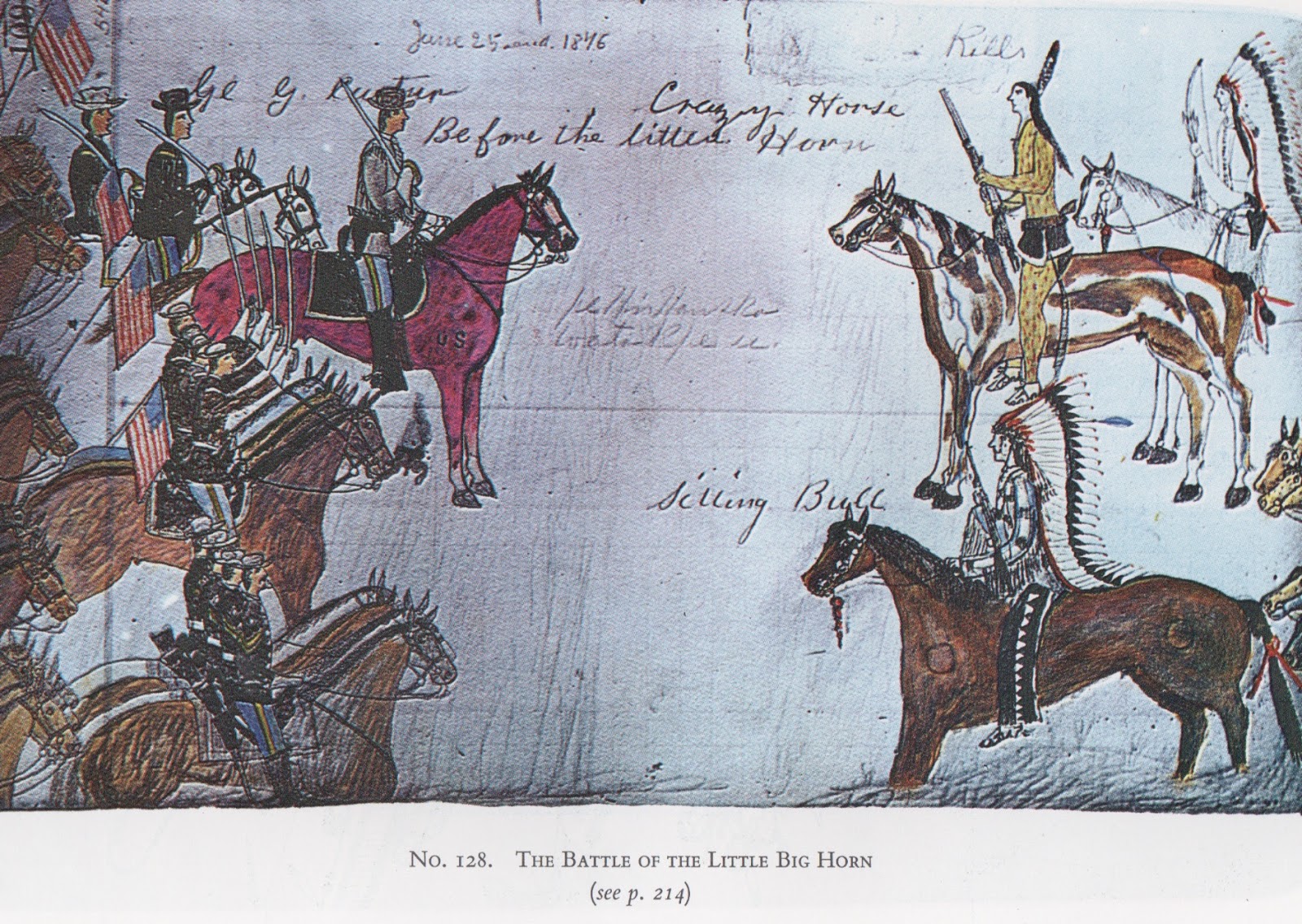
This is the most fascinating book. Amos Bad Heart Bull drew sketches of the history of the Sioux, as he lived, or was told to him. This pictures depict Crow vs Sioux battles, dances, Little Big Horn, Wounded Knee, Indian ceremonies, Sioux games, Sioux life and much more. It includes a section of pictures in color, but most are in black and white. Helen Blish asked the younger sister of Amos Bad Heart Bull if she could study his drawings. This book is the result. The originals were buried with the sister.
![]() |
| Victory Dance or Scalp dance, the items displayed are scalps and human parts. |
![]() |
| Principle Character, Little Big Horn, George Custer, Crazy Horse and Sitting Bull, picture is symbolic |
![]() |
| Crazy Horse and Sitting Bull |
![]() |
| Initial Attack by Captain Marcus Reno |
![]() |
| This attack is turned by Bad Heart Bull, Kicking Bear and Hard to Hit. Bad Heart Bull is father of artist, Kicking Bear was at Wounded Knee |
![]() |
| This picture shows Crazy Horse in the action |
![]() |
| Captain Reno's men in the water |
![]() |
| Principal character at Wounded Knee, Chief Kicking Bear and General Nelson Miles with Grant Short Bull in the middle. I think this is again a symbolic representation |
![]() |
| Samples of Ghost Dance outfit which was suppose to stop bullets |
![]() |
| Murder of Sitting Bull and his son who was shot while in bed. Native American Guards came to arrest Sitting Bull for not stopping the Ghost Dance. There was a struggle and Sitting Bull was killed. |
![]() |
| Ghost Dance Ceremony |
![]() |
| Ghost Dance song |
![]() |
| Ghost Dancers surrounded by infantry and horse troops (there were also four gatling guns present) |
![]() |
| The Massacre |
![]() |
| Women Dancing |
Thursday, June 2, 2016
Native American Biography: Crazy Horse: Sioux
Crazy Horse is considered the greatest of the Sioux Chief, who lead his people to a valiant but futile struggle against White encroachment. He was instrumental in the U.S. Army defeats at Rosebud and Little Big Horn. Crazy Horse was a warrior with great medicine. His father His Horse Looking, bestowed upon him his own name. The Sioux did not face encroachment until after the Civil War. However then it came upon them very fast. They were first determined to open the Bozeman Trail, however after a two year struggle they finally closed the trail. Red Cloud ended the war signing a treaty that they would live on a reservation but that the Black Hills would be Sioux. Crazy Horse never signed a treaty and never lived on a reservation. However reports of wealth in the Black Hills area caused the government to have desires for this area. This started with action against Sioux who lived off of reservations. His camp took in survivors of this early confrontation. he vowed he was going to fight. The first chance case at Rosebud Creek. General Crook and his men were defeated, and made their way back to their base camp. The Indians then moved to Little Big Horn, where 15,000 total, 5,000 warriors were gathered. Little Big Horn was a disaster for the federals. They were to gather their force on June 26, but Custer did not wait for the other resources and attacked a day early. Custer's forces were annihilated while the Sioux did not finish off the other troops traveling with him. SittingBull and Gall retreated to Canada the next spring, but Crazy Horse remained on his own land. The federals caught up with Crazy Horse and his band in January of 1877, but through brave tactics they were able to escape. general Crook sent Red Cloud to talk with Crazy Horse. Crazy Horse finally relented to ease the suffering of his people. He was taken to an agency, not the reservation as promised. As Crazy Horse became more nervous, the federals became more cautious. Finally many men were sent to arrest Crazy Horse. When it became clear to Crazy Horse that he was not being taken to a meeting but to prison he resisted. He drew a knife, but in the struggle he was bayonetted and died from his wound. His band, 2000 strong were being taken to the reservation on the Missouri. On their way they broke from the lines, and headed to Canada. the federal force was too small to stop them.
Sunday, May 29, 2016
Native American Biography: Gertrude Simmons Bonnin: Sioux
![]() |
Saturday, May 28, 2016
Native American Biographies: Red Cloud: Sioux Chief
Red Cloud Oglala Sioux: Red Cloud resisted European Westward expansion, and then when he saw that it was inevitable he helped his people adjust to the new way of life. As a young man he went on war parties against the Crow, Ute and Pawnee. He took his first scalp at age sixteen. His exploits were well known, killing four in one battle, and capturing 50 ponies in another. He was involved in an incident where he killed the leader of the Koya Band of Oglala which lead to a split with the Bad Face or Old Smoke Band to which Red Cloud belonged. Over the years there was a greater and greater White presence, rail roads, telegraph wires and pioneers. Gold was discovered in the Montana area. When forts were built to defend the Bozeman Trail the Sioux and Cheyenne finally had too much. Some Sioux agreed to the forts, but Red Cloud held out.
This lead to what later became known as Red Cloud's War. He and his man almost completely closed travel on the trail. He gained victory over Captain William J. Fetterman and 82 soldiers were killed. This was the worst defeat for the U.S. on the plains until Little Big Horn. The U.S. government dealt with Red Cloud as the head chief of the Sioux, although he was not. Red Cloud hoped to gain a permanent reservation and withdrawal of troops on Sioux lands. He felt this was better policy than the extermination of the Indians which some Whites proposed. A reservation was granted, but then gold was discovered on part of the reservation. This lead to the Sioux War of 1876-77. Red Cloud cautiously talked against this conflict.
Red Cloud lived in a tumultuous period. The economic system of the Sioux was totally disruptive with the over=hunting and demise of the buffalo. On the reservation, there were continued efforts to destroy traditional culture. In this environment Red Cloud tried to balance his response. There were political conflicts with Indian agents. However there was also negative talk from Indians thinking he had given too much, or was too accommodating to Whites. During the Ghost Dance Movement, his silence was interpreted as acceptance. He was balancing on a tight rope. He was not able to satisfy everyone. Wednesday, May 25, 2016
Native American Biographies: John Grass: Sioux
John Grass was a Sioux leader. He attended the Indian School in Carlisle, Pennsylvania. He used his knowledge to better his people. He fought at the Battle of Little Big Horn. He was a friend of Gall. In later life he was most known as a rival to Sitting Bull. The Indian agent Major James McGlaughlin set Grass up as the Sioux leader after Sitting Bull surrendered in 1881. Over Sitting Bull's objections, Grass was manipulated into signing a treaty breaking up the Sioux Reservation. During the Ghost dance movement Grass advocated for peace, which did not make him popular among the Sioux. Reduced property rights, and the federals did not provide food as promised lead to much poverty, which created the environment for the Ghost Dance movement to begin with. When treaty obligations were not met by the government. Grass traveled to Washington as part of a commission to try to convey Lakota grievances. He was known as a good talker, but also as a "yes" man.
Tuesday, May 24, 2016
Native American Biographies: Black Elk: Sioux Prophet
![]() |
| Black Elk L and Elk |
![]() |
| Black Elk, daughter Lucy Black Elk and wife Anna Briggs White |
Thursday, April 14, 2016
Native American Biography: Hollow Horn Bear
eagle coin, and after his death on a U.S. Postage stamp. Brûlée Sioux, Horn Bear proved himself as a warrior, first fighting Pawnees, and later defending the Bozeman Trail from encroachers. His warriors defeated Lieutenant William Fetterman and also harassed Union Pacific work camps. However in the 1870s he became a Peace Chief. He attended two presidential inaugurations, Theodore Roosevelt and Woodrow Wilson. He died after the inauguration of President Wilson as he caught pneumonia.
Wednesday, April 13, 2016
Native American Biography: Billy Mills: Olympic Gold Medalist
![]() |
![]() |